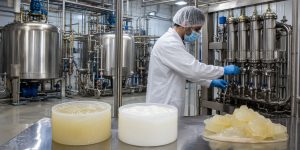

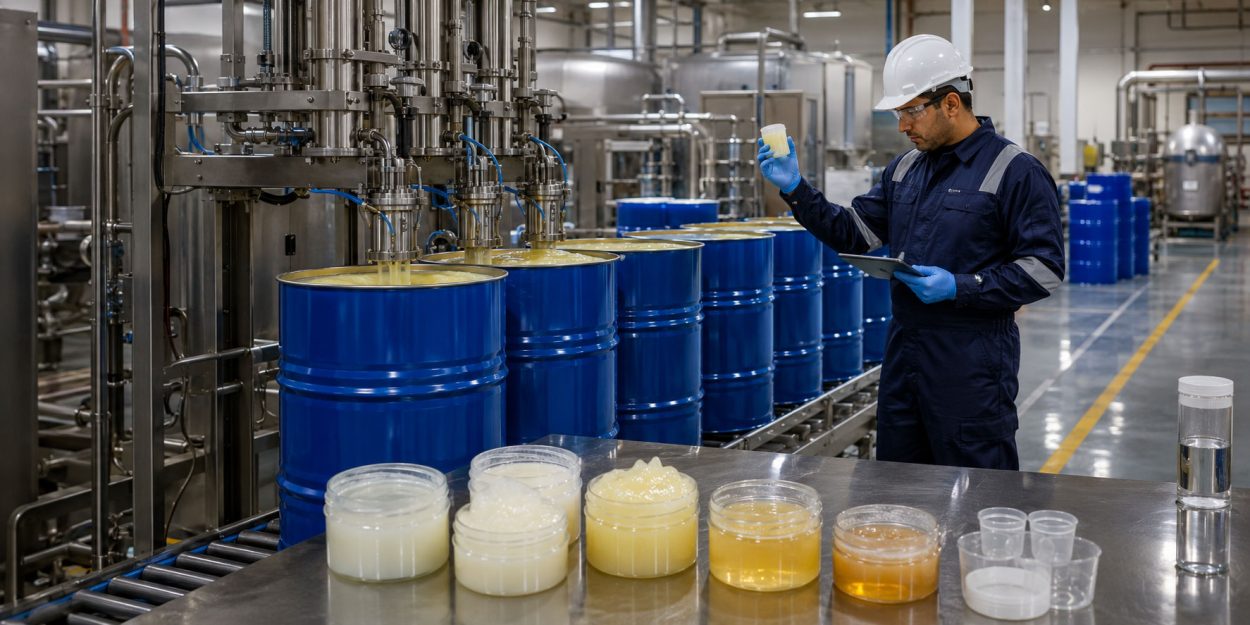
Process guide from receiving refinery feed to packaging the final product
The process of producing industrial petroleum jelly is not limited to distilling crude oil or passing a material through a filter. In a real production line, semi-solid feedstock or oily and waxy components of the required specifications are received, homogenized under controlled heating, decolorized and deodorized if necessary, and after filtration, consistency adjustment, deaeration, cooling and quality control, they are transformed into a marketable product.
To understand the nature of petrolatum, its types, and the difference between industrial grades and human grades, first read the article What Is Vaseline? Read on. This page focuses exclusively on the industrial Vaseline production process, line control factors, and final product acceptance indicators.
Summary production route: Feed reception and evaluation → Melting and homogenization → Pre-treatment → Decolorization and odor reduction → Hot filtration → Consistency adjustment → Deaeration → Controlled cooling → Quality control → Filling and packaging |
What material is industrial Vaseline made from?
Petrolatum is not a pure substance with a single formula; it is a complex mixture of heavy oily and waxy hydrocarbons. Technical definitions define petrolatum as a semi-solid substance that can be obtained from dewaxing residual paraffinic oils, heavy base oil cuts, bright stock, or some vacuum streams. After the semi-finished feedstock is produced, additional processing is performed to achieve the desired color, odor, consistency, and stability.
The waxy part forms a network that holds the oil components and gives the product its jelly-like texture. If the proportion or structure of the oil components is too high, the likelihood of softness and oiliness increases; if the solid part is disproportionate, the product can become hard, grainy or poorly spreadable. The goal of production is therefore not to completely eliminate either wax or oil; but to create a controlled balance between them.
Industrial Vaseline is structurally similar to Paraffin wax They are not the same. Solid paraffin is refined to form a relatively hard waxy mass, while petrolatum must retain some of the oil phase to remain semi-solid and spreadable.
Does the Vaseline factory directly refine crude oil?
In most industrial chains, the answer is no. Atmospheric distillation and vacuum distillation of crude oil are carried out in upstream refineries. The petroleum jelly unit usually receives a more prepared feedstock such as semi-finished petrolatum, semi-solid oil-wax stream or refined components and is responsible for further refining, specification adjustment, batch control and packaging.
Of course, not all plants are the same. Some integrated complexes produce feedstock and final refining on the same site, while others purchase feedstock from a refinery or base oil producer. A professional article should clarify this difference and avoid the simplistic claim that “crude oil enters the line and is transformed into petroleum jelly through a few filters.”
Two common routes for producing industrial Vaseline
The type of feed and the factory equipment determine the production path. In practice, two general patterns are most commonly seen:
Refinement of semi-finished petrolatum
In this route, a semi-solid petroleum feed containing oily and waxy components is received. The main operations include melting, absorption or supplementary refining, hot filtration, homogenization, and specification adjustment. This model is common for producing industrial grades with different colors and consistencies.
Blending of refined components
In the second route, mineral oil and refined wax components are combined in controlled proportions to form a semi-solid product with the desired permeability and dropping point. This method allows for more precise texture control; however, product quality is still dependent on the qualification of the raw materials, compatibility of the components, and control of cooling. The choice of this route does not imply that the product is suitable for human consumption, and the grade is determined solely by the destination documentation and standard.
Overview of the industrial Vaseline production line
The production line can be continuous or batch, but in batch units it is more possible to track and modify the characteristics of each batch. The following steps provide a general and non-exclusive map of the process; temperature, time, pressure, type of adsorbent and agitator speed should be determined based on the equipment design, feed and product specifications.
First stage: Receiving and evaluating feed
A representative sample is taken before the feed is discharged into the main tank. Appearance, color, odor, uniformity, presence of free water, foreign particles, initial consistency and conformity of the consignment documents with the order are checked. Recording of the supplier, batch number, date of receipt and destination tank is essential for traceability.
Feed that is biphasic, watery, has a burnt smell, or is mechanically contaminated should not be put into production without proper treatment, as final treatment is not always able to compensate for improper feed. The stability of raw materials is the basis for the stability of color and consistency of the product in subsequent batches.
Second stage: melting and homogenizing the feed
The semi-solid feed is brought to a pumpable state in a walled tank by indirect heating. The goal is not just to melt; it is to completely homogenize the oil and wax phases without creating hot spots. Local heating or prolonged exposure to high temperatures can intensify color and odor and reduce product stability.
Mixing should be designed for viscous materials. Weak agitation will cause a difference in composition between the top and bottom of the tank, and too vigorous agitation can introduce more air into the material. The temperature, time, and intensity of mixing should be recorded in the manufacturing instructions for each grade.
Common equipment for this stage
- Steel tank with steam heating, hot oil or suitable process system
- Agitator suitable for semi-solid and viscous materials
- Temperature sensor, controller and protection against unwanted temperature increase
- Positive displacement pump and heated or insulated transfer lines
Third stage: Pre-treatment and removal of mechanical contaminants
Before the feed enters the decolorization unit or final filter, passing through a coarse screen or primary filter can remove particles, packaging debris, and mechanical contaminants. This step reduces the load on the final filter and prevents premature clogging of the equipment.
Pretreatment is not a substitute for absorption treatment. A mechanical filter may remove solid particles, but it will not effectively remove the dissolved compounds responsible for color or odor.
Step 4: Decolorization and reduction of unpleasant odors
Industrial feedstock can be yellow, amber, or dark, depending on its origin. The manufacturer must first determine what the target color is, as not all applications require white petrolatum. Over-refining can increase costs, product losses, and adsorbent waste, without adding technical value to the end application.
Absorption treatment
In one common method, the molten feed is contacted with an adsorbent such as decolorizing earth or a suitable adsorbent. The adsorbent binds some of the color-forming compounds, oxidation products, and undesirable materials to its surface. The amount of adsorbent, contact temperature, mixing time, and feed quality have a direct effect on the result.
Historical petrolatum refining documents also describe the use of adsorbents and liquid-phase filtration for decolorization and odor reduction. However, the type of adsorbent or conditions of an old patent should not be copied without an engineering, safety, and economic evaluation as a guideline for today's line.
Supplementary refining
Depending on the supply chain, some of the refining may have been done before the feed enters the plant, using technologies such as solvent extraction or hydrorefining. The downstream unit must know the refining history and feed specifications, as light color alone does not provide sufficient information about unwanted compounds or suitability for sensitive applications.
Step 5: Hot Filtration
After contact with the adsorbent, the material should be filtered while still fluid. Hot filtration separates the spent adsorbent, fine particles, and insolubles from the petrolatum phase. Excessive temperature drop along the path can increase viscosity, reduce flow, and clog the filter.
The quality of this step is assessed by the clarity of the melt sample, the amount of residual particles, the filter pressure difference, and the product recovery efficiency. The passage of adsorbent particles into the final product can cause spot color, texture roughness, and sediment in the container.
Possible filtration equipment
- Filter press with plates and media compatible with process temperature
- Vertical or horizontal leaf filter for higher capacity lines
- Heated bag or cartridge filter for final polishing
- Hot intermediate tank and pump suitable for stabilizing flow rate and pressure
Step Six: Adjusting the consistency and product specifications
After refining, the industrial petroleum jelly should reach the order consistency range. The manufacturer may adjust the permeability, softness, adhesion and thermal behavior by selecting the appropriate feed, mixing batches or adding specified oil and wax components. Any modification should be made according to an approved and traceable manufacturing process.
The consistency suitable for metal shielding is not necessarily suitable for cable, assembly or rubber formulations. For this reason, statements such as “industrial grade Vaseline” without a number and technical range are of limited value. The specification must be defined by the test method, acceptance limits and application.
Step Seven: Ventilation and Humidity Control
Mixing and pumping can trap air in the material. Bubbles appear as voids, reduced apparent weight, or irregular surfaces during filling. Quiet holding in the intermediate tank, proper inlet design, and in some lines, the use of controlled vacuum can help to expel air.
Water ingress into petrolatum is also undesirable. Free water can cause spattering on heating, foaming, corrosion of equipment, and apparent instability. The phrase "aeration for purification" should not be used generically; uncontrolled exposure to air may exacerbate oxidation and discoloration.
Stage 8: Controlled cooling and texture formation
The final texture is not only dependent on the formulation; the thermal history is also important. When cooled, the waxy components form a network and the oil part is fixed in it. Cooling too quickly, large temperature differences or formula instability can lead to graining, surface cracking, shrinkage or oiling.
Some lines fill the product hot and the texture formation is done in the container; others perform some of the cooling in a tank or exchanger. In both cases, the filling temperature, cooling rate, and setting time must be constant and recorded.
Step 9: Filling and packaging
The approved product is filled into a compatible barrel, bucket or container. The packaging must be clean, dry and free from residues of the previous product. Control of net weight, capping, sealing, batch number, production date and control sample are basic requirements.
Containers should be kept away from direct sunlight, dust and heat sources. In hot areas, a change in consistency or softening of the product does not necessarily mean chemical deterioration; however, storage conditions and test temperatures should be considered for proper evaluation.
How is the quality control of industrial Vaseline carried out?
The analysis sheet should be tailored to the product application. Not all tests are necessary for all grades, but the test method and acceptance limits should be known prior to production or purchase.
Appearance, color, odor, and uniformity
The sample is examined for target color, unusual odor, particles, bubbles, oil separation, and granular texture. The appearance evaluation should be performed under constant light and temperature conditions because temperature affects the softness, transparency, and surface of the product.
Consistency measurement with ASTM D937
ASTM D937 measures cone penetration in petrolatum as an empirical measure of firmness or consistency. The penetration number is useful for grade selection and batch consistency control, but it alone does not predict the overall performance of the product in the end application.
Thermal treatment with ASTM D127 and D938
ASTM D127 is used to determine the drop melting point of petroleum waxes, including petrolatum. ASTM D938 also covers the freezing point of petroleum waxes, including petrolatum. The choice of test depends on the contract specifications and customer needs, and “melting point” should not be reported without specifying the method of measurement.
Application-related tests
- Oil quantity, if relevant to product specifications and agreed method
- Odor, color, ash or insoluble matter
- Storage stability and oiling evaluation at defined temperatures
- Compatibility with metal, rubber, polymer or customer process
- Melt viscosity and pumpability, in lines where this is an operational indicator
What factors change the quality of industrial Vaseline?
- Origin, uniformity and history of feed refining
- Balance of oil and wax components and formula stability
- Melting temperature and shelf life of the material in the hot state
- Type, quantity and quality of absorbent and contact time
- Filtration efficiency and particle prevention
- Mixing intensity, air entry and moisture
- Cooling rate, filling temperature and stabilization time
- Cleanliness of tanks, lines and packaging containers
- Storage conditions and temperature fluctuations during transportation
Common defects in industrial vaseline production
Oiling or phase separation
Oil film loss from the texture can be caused by a composition imbalance, a change in feed quality, improper cooling, or storage at temperatures outside the evaluation range. Correction of the defect should be done by reviewing the formulation and thermal history, not just by randomly increasing the waxy fraction.
Granular or heterogeneous texture
Irregular crystallization, inadequate mixing, batch contamination, or uneven cooling can cause the product to be grainy. The sample should be evaluated after a stabilization time and at a specific temperature to avoid confusing temporary texture during filling with a permanent defect.
Dark color or unpleasant odor
Improper feed, insufficient amount of adsorbent, poor filtration, excessive heating, or line contamination are possible causes. Excessive addition of adsorbent without testing can increase product loss and waste generation.
Particles, bubbles or sunken surface
Particles are usually related to mechanical contamination or sorbent pass-through. Bubbles are caused by air entrapment and inadequate deaeration. Surface depressions may also be the result of shrinkage during cooling or improper filling temperatures.
Difference between industrial grade and human grade production routes
Industrial Vaseline is produced based on technical performance and contractual limits. A product that is suitable for an industrial application in terms of color and consistency does not necessarily meet pharmaceutical, cosmetic, or direct skin contact requirements. The difference in grades is not limited to whiteness or the number of filtrations; the source of the feed, the level of refinement, the control of unwanted compounds, test methods, and compliance documentation are important.
Safety warning: Do not use industrial Vaseline on skin, lips, wounds, cosmetics, pharmaceuticals, or food products unless the supplier has documented the appropriate grade and standard for that use. |
Applications of the final product
Once manufactured and specifications are approved, industrial petroleum jelly can be used in temporary coating of metal parts, assembly and light lubrication, moisture-resistant cable compounds, some rubber or polymer formulations, and technical products. Product suitability must be proven by customer application testing, as petrolatum is not a general substitute for grease or specialty lubricants at high loads, speeds, or temperatures.
To study the details of the performance of this material on metal, see the article Industrial Vaseline to protect metal surfaces from moisture and rust See.
What specifications should be checked when buying industrial Vaseline?
Professional selection should start with the application. The buyer should determine the operating temperature, type of surface or polymer, method of application, cleaning requirements, and duration of protection, and then test the sample in real-world conditions.
- Exact grade title and recommended use
- Cone Penetration Range or Consistency Index
- Dropping point or agreed thermal characteristic
- Color, odor, appearance and extent of oil separation
- TDS, analysis sheet for each batch and SDS if needed
- Packaging type and weight, storage conditions and declared shelf life
- Stability of supply and possibility of providing samples before bulk orders
To check the available grades, go to the page Vaseline product Arash Mahya Please refer to it and state your usage specifications before purchasing.
Conclusion
The production of industrial Vaseline is a controlled chain from feed selection to packaging. After receiving the feed from the refinery, the material is melted and homogenized; mechanical impurities, some of the undesirable color and odor are reduced by appropriate methods; the absorbent and particles are separated in hot filtration; then the consistency, air, humidity, cooling, and filling conditions are controlled.
Final quality is not measured by white color or smooth appearance alone. Consistency, dropping point, texture stability, oil separation, cleanliness, batch stability, and compatibility with customer application must be evaluated simultaneously. The use of an industrial product for human consumption is also not permitted without documented grade confirmation.
To receive samples, TDS, CoA and grade selection advice, you can contact the sales department via the page. Contact Arash Mahya Stay connected.
Frequently Asked Questions About Industrial Vaseline Production
What is the raw material of industrial Vaseline?
The feedstock can be semi-finished petrolatum, heavy oil-wax refinery streams, or a combination of refined components. The exact type of feedstock depends on the production model and grade specifications.
Is industrial Vaseline produced directly from crude oil?
Usually no. The distillation of crude oil is done at the upstream refinery, and the Vaseline plant receives a more prepared feed for further refining, consistency adjustment, and packaging.
What are the main steps of the industrial Vaseline production line?
Feed reception, melting, homogenization, pretreatment, decolorization, hot filtration, consistency adjustment, deaeration, cooling, quality control, and packaging are common steps.
How is Vaseline decolorization done?
One method is to contact the molten feed with an absorbent followed by hot filtration. The exact technology depends on the feed, target color, line capacity, and product specifications.
Why does industrial Vaseline leave oil?
Imbalance of the oil and waxy fraction, changes in feed quality, improper refrigeration, or storage at inappropriate temperatures can cause oil separation.
How is the consistency of industrial Vaseline measured?
ASTM D937 uses cone penetration as an experimental measure of the consistency or firmness of petrolatum.
What is the importance of the dripping point?
This index indicates the thermal behavior and onset of product shedding under test conditions and is useful for controlling grade stability and comparing batches.
Is white Vaseline always better quality?
No. Color is just one of the characteristics. Consistency, stability, odor, cleanliness, testing method, and suitability for use should also be considered.
Can industrial Vaseline be used on the skin?
No, unless the product is documented for human use and meets the relevant standard. Light color alone does not qualify for dermal use.