The difference between light and heavy slack wax should be sought in the grade specifications, feed composition and its behavior in the production line. The name light or heavy does not alone determine the oil percentage, quality or suitability for an application. To make a choice, put together analysis sheets with the same test method and conditions and compare the oil percentage, thermal behavior and viscosity with the process requirements. In this guide, we at Arash Mahya explain how to get from the brand name of the grade to a verifiable technical comparison.
What do light and heavy describe?
Light Slack Wax and Heavy Slack Wax are names used to distinguish grades in this family. This distinction is related to the type of feed cut and the distribution of hydrocarbon compounds, but these two names should not be used as a global standard with fixed numerical limits. It should first be clarified on what basis the supplier has named the grades.
In a product range, the heavier grade may have a higher viscosity or melting point; this pattern cannot be generalized to two products from different sources without analysis. Also, “light” does not necessarily mean less oil and “heavy” does not necessarily mean more oil.
When receiving a quote, record the grade name along with the product code and measurable specifications. The English phrase Light Heavy Slack Wax is not a complete answer to feed selection without this information. The name is only a starting point for consideration; acceptance criteria must be defined for the sample and the consignment in question.
Comparing properties under identical test conditions
Before comparing numbers, identify the type of document. Typical values give a picture of the product; Specification limits are agreed-upon acceptance criteria; COA reports the test result of a specific batch. Do not equate a typical value with a definitive result for a shipment. To compare two proposals, it is best to have both the acceptance limits and the proposed batch analysis available.
If one vendor only sends a general product range and another sends a batch test result, the comparison is still not level. Record the document date, batch number, unit, and test method on a common sheet. For numbers where the method or conditions are not clear, ask for clarification before rating the samples.
Oil percentage and test method limitations
Oil percentage is an important evaluation variable, but it is not the sole definition of light or heavy. Its importance depends on the role of the feed in the final product. For a unit that extracts oil, it is important to consider the efficiency and load of the finishing operation; for a formula that accepts part of the oil, the result of the performance test can make a different decision.
In Official ASTM D721 scopeThe method is defined for waxes with a freezing point of at least 30°C and a maximum of 15% oil. In some samples with more than 5% oil, incompatibility with MEK solvent can make the method unsuitable. Therefore, simply including the name D721 on the sheet of each oily slack wax is not sufficient; the laboratory must confirm the applicability of the method.
Thermal behavior and viscosity
Melting point, freezing point, and flash point are not the same properties. ASTM D938 It is related to the freezing point and the formation of resistance to flow when cooled; ASTM D87 It checks the melting point with a cooling curve and is not suitable for all wax families. Do not directly base the superiority of one sample on two numbers with different titles.
Viscosity should also be reported with the test temperature and unit. Do not compare a number measured at 100°C with a number at another temperature. Also, the melting point or flash point cannot be used to derive the allowable storage and operating temperature; this decision requires documentation of the same grade and equipment conditions.
Comparison table of two hypothetical examples
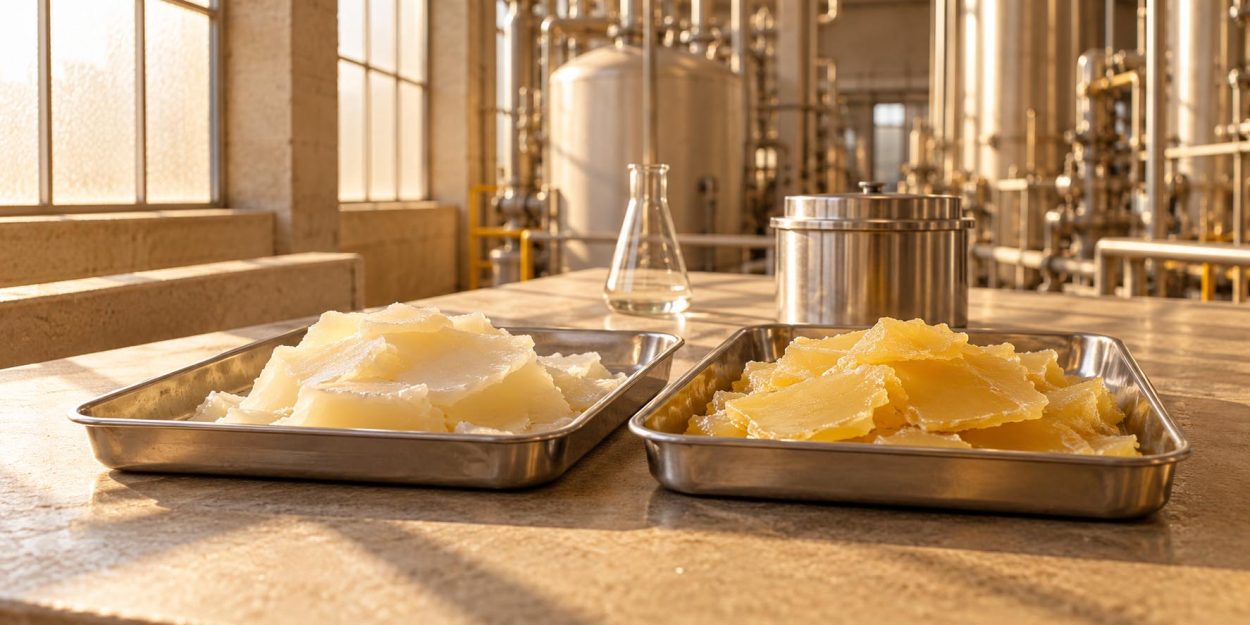
The following table is a purely hypothetical training example; no actual COA or specifications for Arash's offering are available. It is assumed that the vendor has identified Sample A as light and Sample B as heavy, and the methods outlined are applicable to these samples. The purpose is to practice data interpretation; the numbers are not standard ranges for these two groups.
| Property | Hypothetical Sample A | Hypothetical Sample B | Effect on decision process | Ask the seller |
|---|---|---|---|---|
| Oil percentage, mass; D721 | ۸٪ | ۶٪ | The heavy name in this example is not associated with more oil. | Is the method validated for the sample? |
| Freezing point; D938 | ۵۲°C | ۵۸°C | The cooling behavior of the two samples is different. | Is the data consistent with the transmission and cooling requirements of the line? |
| Kinematic viscosity at 100°C; D445 | ۴٫۵ cSt | ۷٫۰ cSt | To evaluate melt flow and mixing, check | How does the process behave at actual temperature? |
| Appearance under identical viewing conditions | Light yellow | Cream | Appearance does not prove performance or level of purification | What are the results of the performance test and grade documents? |
In this example, sample B, despite being labeled as heavy, has less oil. This result is only for the hypothetical data in the table. The higher viscosity of B is also not an advantage in itself; it is necessary to see what range the equipment and formula will accept. Its lighter appearance is also not a substitute for performance testing.
Three choice scenarios
Scenario 1: A unit that degreases the feed
In this unit, the main question is how much acceptable product each feed will yield, at what processing time and cost. To compare light and heavy slack wax, evaluate samples with the same procedure and record the yield, output quality, and byproducts. Just because there is less oil does not determine the final yield.
If two samples achieve similar quality after processing, the actual energy, time and yield data can be set aside from the feed cost. If the output quality is different, first check the feasibility of achieving the target specifications. This assessment is not intended to recommend a production method or guarantee the profitability of a particular grade.
Second scenario: Industrial formula with flow limitation and cooling
Suppose a feed change is being considered in an industrial coating formulation. In this case, don’t just measure the melting time of the sample; mixing at the allowable temperature, transferability, and product condition after cooling should also be included in the test program. Establish test conditions, component ratios, and acceptance criteria before comparison.
A sample in the tank may behave acceptably, but the formulation output may not meet the consumer's needs. Therefore, base the choice of heavy or light slack wax on the test results of that formulation. The general use of a material family in coatings does not guarantee all grades for all coatings.
Third scenario: feed replacement in the active line
For substitution, the reference sample is the same feed that has been shown to perform well on the line. Analyze the new sample next to it and note the differences. Then perform a limited, controlled test; changing multiple formula components at once makes it difficult to determine the cause of the result.
On the evaluation sheet, in addition to the final result, write down the working conditions and the reason for rejecting or accepting the sample. If a batch is accepted, do not consider it a guarantee of the performance of all future batches. For continued supply, the specification limits, the method of batch control, and the handling of deviations must be clear.
What data changes the decision?
Before choosing, answer these questions for each offer:
Is the name light or heavy attached to the product code and vendor-specific definition?
Do the two analyses have comparable units, methods, and test temperatures?
Is the test sample traceable to the proposed batch for delivery?
Are the final product acceptance limits and line test conditions documented in advance?
Does the result only describe the appearance, or has the required functionality also been considered?
If the answer to one of the questions affecting consumption is not clear, base the decision on receiving that data. For example, the lack of viscosity at the process temperature cannot be compensated for by the description “heavy, high-quality grade.” The test report should resolve the specific ambiguity of the decision.
Two common questions about the difference between light and heavy slack wax
Is heavy always oilier?
No. The heavy name alone does not determine the amount of oil. For two specific products, check the analysis result with the applicable method and the agreed limits. One should not conclude from the numbers of one supplier the definitive limits of the entire market.
Is a brighter appearance enough to make a choice?
No. Appearance may be one of the product criteria, but it alone does not prove formulation consistency, processing efficiency, or food and pharmaceutical grade. Acceptance for sensitive applications requires documentation of the same product.
Selection based on production line needs
To evaluate the difference between light and heavy slack wax, start with the grade name and proceed to the conditional analysis, acceptance limits, and consumption test. At Arash Mahya, we make the clarity of specifications and consumption needs the basis of the conversation with the buyer. To review Slack Wax Specifications and SupplySend the description of usage, required specifications, quantity, and delivery destination to Arash Mahya.