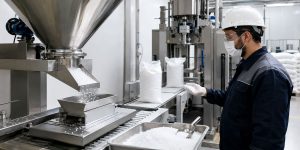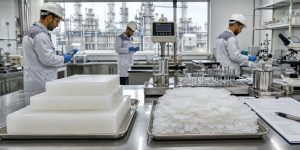

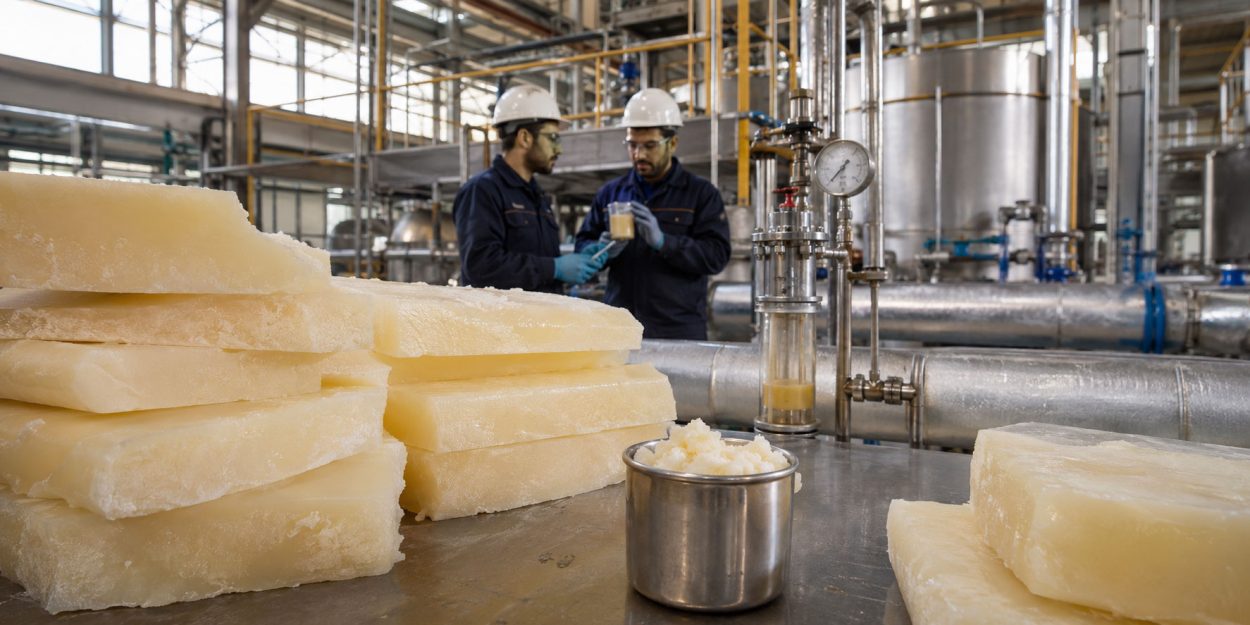
The raw materials for paraffin production are not simply described by the term “crude oil.” Crude oil is the upstream source of the chain, but in the conventional route for producing solid petroleum paraffin, the feedstock that enters the refining and oiling stages is usually slack wax, an intermediate product obtained from the process of producing base oil and separating waxy compounds.
From a producer’s perspective, understanding the feedstock is valuable when it can be linked to the quality of the final product. Oil content, melting point, color and odor, impurity levels, and batch uniformity can all affect the intensity of the refining process, production efficiency, and consistency of the paraffin’s characteristics. For this reason, rather than reiterating the general definitions and applications of paraffin, we focus in this guide on the paraffin raw material and the criteria that are of real importance in industrial decision-making.
What is the main raw material for paraffin production?
For a precise answer, it is necessary to distinguish between “source” and “direct feed.” The source of many petroleum paraffins is crude oil; however, crude oil does not enter the paraffin wax production line directly. First, suitable cuts are separated in the refinery and processed in the production of base oils. In the dewaxing stage, the waxy part is separated from the oil, forming a product called slack wax.
So when we talk about raw materials for the production of solid paraffin, slack wax is one of the most important direct industrial feeds. It is a mixture of waxy hydrocarbons and some residual oil and requires deoiling and additional refining steps to convert it into paraffin with controlled specifications.
This simple distinction avoids a common mistake: crude oil is the starting point of the refining chain; slack wax is the intermediate and operational feedstock for the production of many grades of paraffin wax.
How is slack wax converted into feedstock for paraffin production?
In base oil refining, the goal is not just to produce oil. Some petroleum fractions contain waxy compounds that can affect the behavior of the oil at low temperatures. In the dewaxing process, this waxy portion is separated from the oil phase. The resulting waxy product, depending on the refinery source and process conditions, contains varying amounts of oil and hydrocarbon compounds and is known as slack wax.
Slack wax is not a finished, ready-to-use paraffin. Its specifications determine how much finishing is required to achieve the desired product. For this reason, checking the grade and technical characteristics Slack Wax Before entering the process, it is considered part of quality and production cost management.
In simple terms, the upstream path can be seen as follows: crude oil → suitable refinery cuts → base oil production and dewaxing → slack wax. From this point on, the issue enters the realm of paraffin deoiling and refining, which should be considered separately from the discussion of raw materials.
5 important characteristics in evaluating raw materials for paraffin production
Two batches with the same name do not necessarily behave the same on the production line. When evaluating feed, it is not enough to look only at the brand name or price per ton; their technical specifications and stability must be considered alongside the end product purpose. The following five factors are among the most important indicators that can influence feed selection.
1. Oil Content
Oil content is a key indicator of slack wax. The more oil remaining in the feed, the more separation and process control is usually required to achieve a lower oil paraffin. This can affect yield, processing time and overall cost. Of course, oil content is not “alone” a measure of whether a feed is good or bad; the right grade must be matched to the capacity of the production unit and the specifications of the target product.
2. Melting point and thermal behavior
The melting point and thermal behavior range indicate how the feed behaves on heating, cooling, and the formation of wax phases. This characteristic affects the crystallization and separation conditions and must be consistent with the expected final product. Differences in feed source and hydrocarbon distribution can cause two slack waxes with similar appearances to have different thermal behavior.
3. Color and odor
Color and odor are not just visual characteristics. In industrial feed, these two indicators can be an indication of the feed composition and the amount of finishing required. A darker or off-odor feed may require additional purification steps to achieve a clear, odorless paraffin. Therefore, their evaluation should be done in conjunction with other laboratory results.
4. Impurities and quality of primary refining
The presence of undesirable impurities can complicate the subsequent refining process and affect the color, odor, stability, and quality of the final product. For this reason, paraffin raw materials should not be compared solely on the basis of purchase price. What matters in practice is the cost of converting the feedstock into a product that meets the technical specifications required by the customer or target market.
5. Uniformity of feed batches
In industrial production, feed consistency is as important as the specifications of a sample. If the oil content, thermal behavior, or color varies greatly from batch to batch, it becomes more difficult to adjust process conditions and maintain uniformity of the final paraffin. From our perspective at Arash Mahya, quality control is not just about testing the final product; knowing and monitoring the input materials is part of the path to achieving predictable production.
What effect do feed specifications have on the quality of the final paraffin?
Paraffin quality is not the result of a single factor. The feed, the oiling method, the refining conditions and the process control together shape the final product. However, the quality and consistency of the feed is the starting point of this chain and can limit or facilitate the scope for subsequent adjustments.
| Feed feature | Possible impact on the process or final product |
| Higher oil percentage | Greater need for lubrication and separation control |
| High fluctuation between children | Greater difficulty in maintaining uniform grade and specifications |
| Unpleasant color or odor | Increased need for additional purification operations |
| Inappropriate thermal behavior | Changing crystallization and separation conditions |
| Sustainable and balanced food | Better control of the process, yield and quality of the target product |
For example, if the goal is to produce paraffin with a low oil content and a clear appearance, choosing a feed that is compatible with the oil extraction and refining capacity of the unit becomes directly important. Conversely, purchasing a cheaper but unstable feed may introduce higher hidden costs into production.
Are all types of paraffin produced from the same raw material?
No. The term "paraffin" is used for several product groups and the production process is not all the same. In the discussion of solid petroleum paraffin or Paraffin Wax, slack wax is a common and important feedstock. However, liquid paraffin or White Oil is produced in a different way from the refining and purification of mineral oil fractions and should not be considered simply a product of slack wax oil extraction.
For this reason, the term raw material for paraffin production should always be interpreted in conjunction with the type of final product. When the target is solid paraffin, the characteristics of the slack wax and the quality of the separation operation are of primary importance; when the target is liquid paraffin, the type of oil cut and the intensity of its purification are a different matter. To understand the differences in products, see page Types of paraffin and its uses It is a more appropriate path to continue studying.
What happens from slack wax to final paraffin?
After selecting and receiving the feed, the main goal is to reduce the oil and eliminate or reduce the components that do not meet the specifications of the final product. Depending on the line technology, oil extraction can be based on temperature control, crystallization, separation and additional purification steps. Then, the color, odor, oil content, melting point and other product characteristics are controlled to achieve the desired grade.
This article does not go into the operational details of these steps to maintain the scope of the topic. A full description of the path from receiving Slack Wax to refining, separation and product control is provided in the guide. Paraffin Production Process We have explained.
Why is choosing the right feed important in paraffin production?
Paraffin raw materials are not just the initial purchase cost; their quality can affect the amount of additional operations, resource consumption, conversion efficiency, and final product stability. For this reason, in industrial purchasing, it is best to evaluate the price per ton alongside technical analysis and feed conversion capability.
At Arash Mahya, we look at feed based on its relationship to the target product. Oil percentage, melting point, color, odor, and batch uniformity become meaningful when we know what grade is going to be produced in the end. This perspective helps transform the purchasing decision from a purely price comparison to a technical and economic decision.
So, if the question is, “What is paraffin made from?” the short answer is: Petroleum paraffins originate from crude oil, but for the production of many grades of solid paraffin, slack wax is the direct and determining feedstock for the process. The quality of this feedstock will be the starting point for quality control of the final product.
Inquiry about technical analysis, grade and price Slack Wax Suitable for paraffin production
Frequently asked questions about raw materials for paraffin production
What is the main raw material for producing solid paraffin?
In the conventional production route of petroleum solid paraffin, slack wax is one of the most important direct feeds. It is obtained during the dewaxing stage of base oils and requires further deoiling and refining to reach the final paraffin.
Is Slack Wax the same as paraffin?
No. Slack wax is an intermediate product containing a waxy portion and some oil. The final paraffin wax is produced after the oil is reduced and the necessary steps are taken to achieve the desired specifications.
Is paraffin produced directly from crude oil?
Not in the sense of crude oil entering the paraffin production line directly. Crude oil is an upstream source and is first converted into various refinery cuts. In the solid paraffin production chain, slack wax from the dewaxing of base oils can be a direct feed to the paraffin unit.
What effect does the percentage of slack wax oil have on paraffin production?
The oil percentage indicates how much oil component remains in the feed. Increasing it usually requires more oiling operations, but grade selection should be based on the target product, line technology, and process economics.
Is liquid paraffin also produced from slack wax?
Liquid paraffin or White Oil is usually produced by refining and purifying mineral oil fractions, and its process is not the same as producing solid paraffin from slack wax. Therefore, when examining raw materials, the type of paraffin in question must first be determined.