

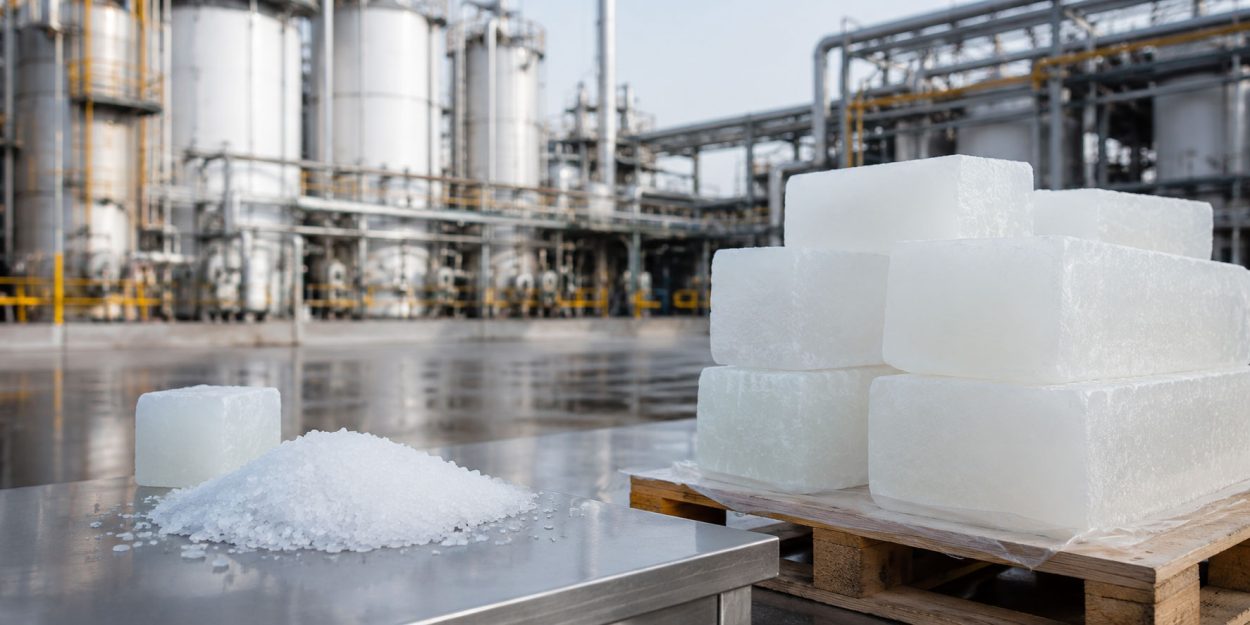
Light paraffin is one of the most common grades of paraffin wax in the raw materials market, falling into the category of saturated petroleum hydrocarbons. This name is usually used to distinguish a grade from heavier types, but "light" alone does not convey the full technical characteristics of the product. Factors such as oil percentage, melting point, color, odor, degree of refinement, and form of supply should be considered for industrial selection.
At Arash Mahya, when evaluating a paraffin grade, we consider the product brand as the starting point and make the final decision based on the cargo specifications and process requirements. Below, we will see what light paraffin is, how it is produced, how it differs from heavy paraffin, and what points to consider when choosing it.
What is light paraffin and what are its characteristics?
Light paraffin is a type of petroleum wax obtained after the separation and purification of paraffinic fractions and is usually seen in solid form at room temperature. This material consists of a mixture of saturated hydrocarbons and its structure is in the paraffin wax family. In the Iranian market, the term light is more of a trade name and a practical way to distinguish some grades from heavier paraffins; therefore, it should not be considered equivalent to a single standard with a fixed number.
The characteristics that are important in practice for identifying a grade include oil percentage, melting point range, color, clarity, odor, and degree of refinement. Two products that are both marketed as light grade may differ in one or more of these indicators. For this reason, for industrial use, the technical specifications or product analysis sheet are more important than the name on the package.
If your goal is to understand the general family of this material and the solid grades, study the page Paraffin wax It provides a more complete picture of its classification.
How is light paraffin produced?
The path to producing paraffin wax begins with oil refining. In the refining process, the oil fractions containing waxy substances are separated, and a product such as slack wax is obtained as a feedstock for subsequent stages. Then, various paraffin grades are produced through processes to reduce oil and increase purity.
The type of feed, the intensity of oil extraction and the level of refining can all affect the characteristics of the final product. For this reason, it is not possible to conclude all the characteristics of a consignment just by hearing the name “grade”. For example, two grades may be close in appearance but have different oil percentages or melting points, a difference that is visible in the production process of the final product.
What is the difference between light paraffin and heavy paraffin?
The difference between light and heavy paraffin wax is best viewed in a comparative manner based on technical specifications, rather than an absolute definition. In many market offerings, the light grade is known to have a softer texture or lower melting range than the heavy grade from the same supplier; however, this pattern cannot be generalized to all products without analytical review.
| Parameter | Light paraffin | Heavy paraffin |
| Naming | Lighter grade commercial separation | Commercial separation of heavier grades |
| Texture and thermal behavior | Grade dependent; usually softer than internal | Grade-dependent; usually harder in internal comparisons |
| Oil percentage | Must be checked from TDS or COA | Must be checked from TDS or COA |
| Melting point | Must be controlled for the same product | Must be controlled for the same product |
| Application selection | Based on formulation and process | Based on formulation and process |
A common mistake is to equate lightness or heaviness directly with higher or lower quality. These two terms are more helpful in distinguishing grades. The right product is one whose specification range is compatible with your process. For example, hardness, shrinkage, surface appearance, and melting behavior can be more important to a candle or wax manufacturer than the brand name of the grade.
What are the uses of light paraffin?
The application of this grade depends on the actual product specifications. It is used in various industries that require a hydrocarbon wax with specific thermal and physical behavior. The three major application groups can be summarized as follows:
Candles and wax products
In the production of some candles, the choice of wax affects the appearance, hardness, release, colorability, and burning behavior of the product. Light paraffin can be suitable in some formulations, but its selection should be made with regard to the type of candle, additives, and grade specifications. Lightness alone does not guarantee the desired result in all formulations.
Waxes, polishes and industrial coatings
Paraffin waxes are used in the formulation of some waxes, polishes, and coatings to provide properties such as hydrophobicity, lubricity, or texture modification. In these applications, too, the percentage of oil, melting point, and compatibility with other components in the formula determine how suitable a grade is.
Manufacturing processes and related formulations
In some industries, paraffin wax is used as an auxiliary material or part of the formulation. The needs of each production line are different; therefore, before replacing one grade with another, its effect on the process temperature, texture, appearance and performance of the final product should be investigated.
In what forms is light paraffin available?
This product may be supplied in block, slab, crushed pieces or granules, depending on the manufacturer or supplier. The physical form mainly affects ease of handling, storage, weighing and feeding into the production line and does not necessarily indicate a difference in the chemical nature of the grade.
For industrial supply, it is better to check the form of supply, packaging weight, batch uniformity and the possibility of obtaining an analysis sheet in addition to checking. If your topic is liquid paraffin and its difference from solid grades, page Types of liquid paraffin It covers this category separately.
What specifications should we look for when choosing light paraffin?
To select this grade, go through the product name and match the technical specifications to the process requirements. In industrial evaluation, these are more important:
- Oil percentage: Affects hardness, appearance, processing behavior, and some properties of the final product.
- Melting point or melting range: It should be consistent with your operating temperature and production conditions.
- Color and odor: These must be controlled in products where the final appearance or odor is sensitive.
- Level of purification: Different grades can vary in purity and appearance.
- Supply and packaging form: Important for storage, weighing, and feeding the production line.
- Batch-to-batch consistency: In continuous production, consistency of specifications from one batch to the next is of great importance.
- Technical documents: TDS and, if possible, COA of the same shipment are a more reliable basis for decision-making.
From experience in the raw materials market, a common mistake is to have a sample in one formulation perform well and then substitute the same brand from another supplier without checking the specifications. If the composition or specification range of the two grades is not the same, the end result of the production line will not necessarily be the same. For sensitive applications, testing a sample before purchasing a large volume is a lower risk decision.
Is light paraffin always a better choice?
No. Neither light grade nor heavy paraffin is an absolute better option. The correct choice depends on the end product, process temperature, expected hardness, appearance, additives, and other formulation requirements. Even within the same industry, two manufacturers may require two different grades due to differences in equipment or formulation.
So if the goal is to select a raw material, first define the process specifications and then measure the product against them. This method is more accurate than selecting based solely on the grade name and reduces the likelihood of variation in the quality of the final product between batches.
Conclusion
This grade is one of the most common types of paraffin waxes, but the name “light” alone is not enough to define quality or determine application. Understanding the oil percentage, melting point, degree of refinement, color, supply form, and stability of specifications will help you choose a more suitable product for your process. The difference with heavy paraffin should also be examined in the same context and by comparing technical sheets. At Arash Mahya, we consider the basis for industrial selection to be matching the actual product specifications to production needs; not relying on a trade name.
Frequently Asked Questions
What Is Light Paraffin?
This product is a grade of petroleum paraffin waxes used to differentiate it from some of the heavier grades on the market. Its exact specifications should be checked from the technical data sheet of the same product.
What is the difference between light and heavy paraffin?
The main difference cannot be determined by name alone. Texture, oil content, melting point, degree of refinement and processing behavior must be compared for the two grades.
What are the uses of this grade?
Depending on the grade specifications, it can be used in candles and wax products, waxes and polishes, coatings, and some industrial formulations.
What information is needed to choose this grade?
It is best to match the oil percentage, melting range, color, odor, level of purification, supply form, and TDS or COA of the product to the needs of your production line.