

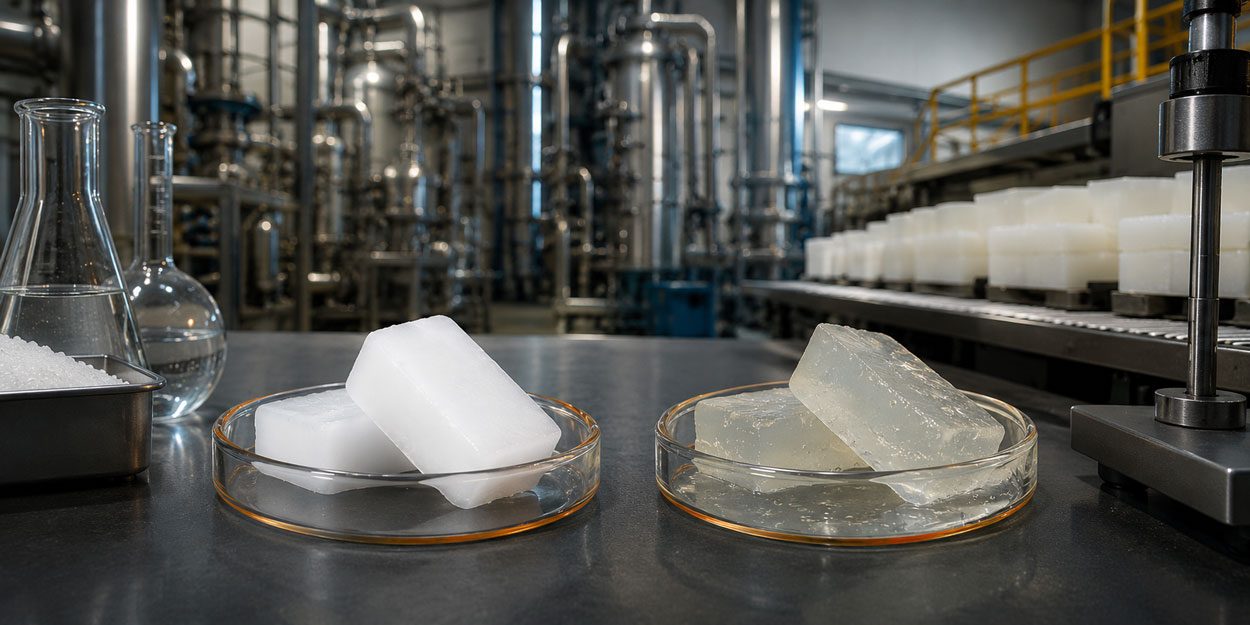
If you are planning to buy or use paraffin, you have probably come across terms like 1percent paraffin and 3percent paraffin. Many buyers think that these numbers indicate the quality of the product, when in fact these percentages refer to the residual oilamount(Oil Content) in the paraffin structure, and this characteristic can affect the color, transparency, flexibility, application and even the final price of the product.
1% and 3% paraffin are actually different grades. Paraffin wax They are used in various industries, depending on the amount of remaining oil.
Understanding the difference between 1% and 3% paraffin is especially important for candle, cosmetic, packaging, rubber, and other industrial users because choosing the wrong grade may affect the quality of the final product or production costs. In many cases, 1% paraffin is not necessarily the best choice, and 3% paraffin can be a more suitable and economical option depending on the type of application.
In this article, we will first examine the concept of oil percentage in paraffin, then explain the main differences between 1% and 3% paraffin in terms of technical and appearance characteristics in the form of a practical comparison, and then review the most suitable applications for each grade and important points for selecting and purchasing it so that you can make the best decision based on your actual needs.
What do 1% and 3% paraffin mean?
To understand the difference between 1% and 3% paraffin, you must first understand the concept of Oil percentage (Oil Content) Let's get acquainted. In the paraffin production process, after separating the wax from the petroleum base oils, a very small amount of oil remains in the product structure. This amount is known as the oil content and is usually classified as 0.5%, 1%, 1.5%, 3% and higher values.
Simply put, Paraffin ۱ Percentage It has a maximum of about one percent residual oil, while Paraffin ۳ Percentage It contains about three percent oil. The lower the oil content, the lighter the color, the clearer, and the higher the purity of the paraffin. Conversely, increasing the oil content can increase flexibility and reduce production costs, which can be an advantage for some industrial applications.
The important point is that the percentage of oil alone is not a criterion for the superiority of a product. The selection of the appropriate grade should be based on the type of use, the required features and the project budget. For this reason, many industrial manufacturers and users may prefer 3% paraffin to 1% paraffin, depending on the type of final product.
The relationship between oil percentage and the paraffin production process
In the process of refining and producing paraffin, the more carefully and in more stages the deoiling operation is performed, the less oil remains and the paraffin is obtained with a lower oil percentage. In addition to affecting the purity of the product, this process also affects characteristics such as color, transparency, hardness, and final price.
Typically, paraffins with lower oil percentages are used in products where appearance, color, and surface quality are more important, while paraffins with higher oil percentages are a good choice for some industrial applications where flexibility or economy are a priority.
Comparison table of 1% and 3% paraffin
Although the main difference between the two grades is the amount of residual oil, this small difference can have a significant impact on their physical properties, appearance, and application. For this reason, industrial manufacturers and buyers often consider characteristics such as clarity, color, melting point, and compatibility with the production process in addition to price when selecting paraffin.
The table below shows the most important differences between 1% and 3% paraffin:
Feature | Paraffin1% | Paraffin3% |
Oil Content | About 1% | About 3% |
Appearance color | Whiter and brighter | Creamy or light yellow |
Transparency | More | Less |
Sincerity | Higher | Relatively less |
Texture and hardness | Tougher and more stable | Softer and more flexible |
price | Higher due to further purification process | More convenient and economical |
Common uses | High-quality candles, cosmetic products, sensitive industries | General candle making, packaging, rubber and various industries |
Differences in color and transparency
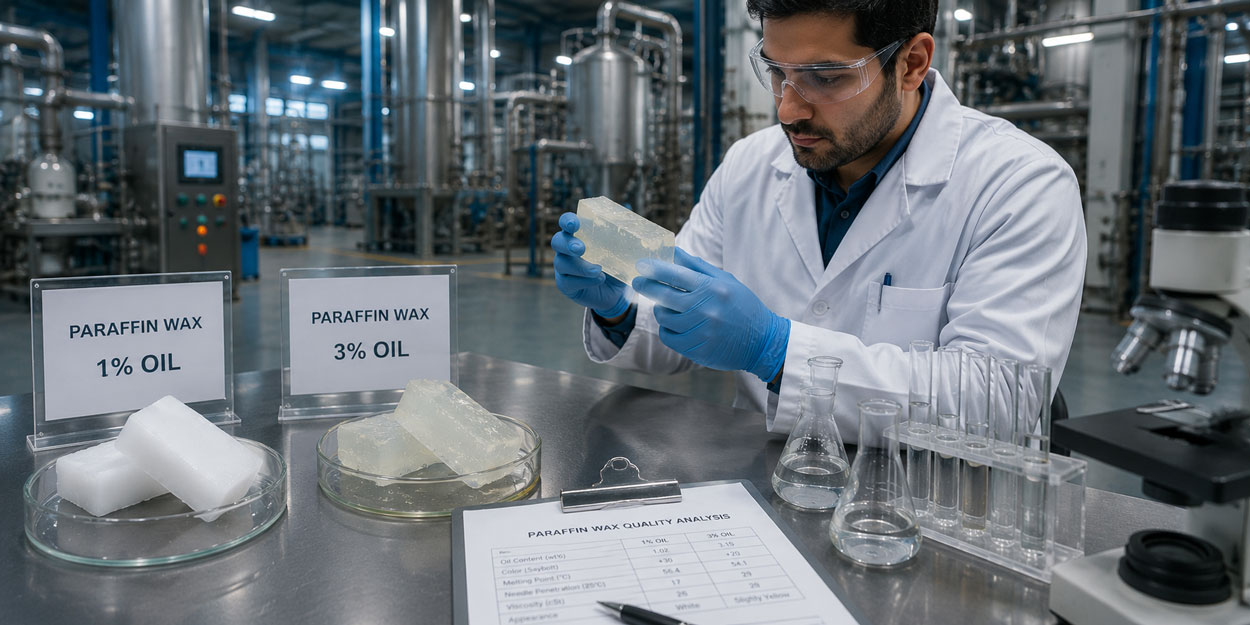
One of the first differences that you will notice when looking at these two types of paraffin is their color and transparency. Because more of the oil has been removed, 1% paraffin usually has a brighter, clearer appearance and is a more desirable choice for products where appearance is important. In contrast, 3% paraffin may be slightly more opaque or cream-colored due to the higher oil content.
Difference in price and purchase value
Many buyers think that the price difference between these two products is only due to the difference in brand or build quality, but the main factor is... Purification process and degreasing rate Producing paraffin with a lower oil percentage requires more processing steps, which increases the cost of production.
However, more expensive doesn't always mean a better choice. If your final product doesn't require high clarity or higher purity, using 3% paraffin can manage production costs without a noticeable reduction in quality.
Is 1% paraffin always of higher quality?
In terms of purity and appearance, 1% paraffin is at a higher level; however, choosing the best grade depends entirely on the type of application. For example, in the production of some decorative candles or cosmetic products, using 1% paraffin can produce better results. In contrast, for many general and industrial uses, 3% paraffin will be a logical and cost-effective choice due to its more affordable price and desirable physical properties.
For this reason, experts in this field usually recommend that before purchasing, in addition to the oil percentage, technical specifications, melting point, and intended application be checked so that the final selection is made based on actual needs.
Applications of 1% and 3% paraffin in various industries
One of the most important points to consider when choosing paraffin is: Suitability of product features to the type of application In practice, no grade can be considered the best option for all industries, as each application has its own technical requirements. For this reason, industrial producers and consumers select the appropriate grade based on factors such as clarity, oil content, melting point, and cost.
In what industries is 1% paraffin used?
Due to its higher purity and lighter color, 1% paraffin is mostly used in products where appearance quality and uniformity are of great importance. The most important applications of this grade include the following:
- Production of decorative, luxury and export candles
- Manufacturing of some cosmetic products and paraffin-based creams
- Food packaging and protective coatings industries with higher standards
- Production of paraffined papers and some sensitive industrial products
- Formulation of products that require greater clarity and purity
In these applications, the light color, reduced odor, and uniform appearance of 1% paraffin can improve the quality of the final product.
In some cosmetic, health and industrial formulations, in addition to solid paraffin, Liquid paraffin It is also used to create desired physical properties and texture.
In what industries is 3% paraffin used?
3% paraffin is one of the most widely used grades on the market due to its more economical price and good flexibility. This product performs well in many industrial processes and is usually chosen for applications where minor differences in color or clarity do not significantly affect the final product.
The most common uses of 3% paraffin include:
- Production of general candles and economic candles
- Rubber and tire industries
- Match and compressed board industries
- Production of various waxes and polishes
- Packaging and insulation industries
- Some processes for producing adhesives and chemicals
In these industries, the affordable cost and easier availability of 3% paraffin has made it a practical and cost-effective option.
Is 1% or 3% paraffin better for candle making?
One of the most frequently asked questions by buyers is related to the candle industry. The answer to this question depends on the type of candle being produced. If the goal is to produce decorative, scented candles, or high-quality, luxurious-looking products, 1% paraffin is usually a better choice due to its higher clarity and purity.
However, in the mass production of general and economical candles, many manufacturers use 3% paraffin because this grade reduces the cost of raw materials and is more economically viable while maintaining acceptable quality.
Choosing paraffin based on needs, not just oil percentage
One common mistake in the market is that buyers assume that paraffin with a lower oil percentage is the better choice in all circumstances. While a professional choice should be made based on a set of factors including the type of application, required technical features, budget, end product specifications, and technical analysis of the paraffin.
In other words, if the final product requires high transparency and a premium appearance, 1% paraffin may be a more suitable option; however, if the goal is to reduce production costs and use in general or industrial applications, 3% paraffin can also provide quite satisfactory performance.
Is 1% or 3% paraffin better? Selection guide based on type of use
After becoming familiar with the technical differences and applications of each grade, the question arises: Paraffin ۱ Which is the better choice, percentage or paraffin? ۳ Percentage? The reality is that there is no fixed answer to this question and the right choice depends on the consumer's needs and the features of the final product.
In general, if your priority is to produce a product with a clearer appearance, brighter color, and higher purity, 1% paraffin is a better choice. However, if you are looking to manage costs and use paraffin in general or industrial applications, 3% paraffin can be a more economical choice while maintaining acceptable quality.
When to choose 1% paraffin?
1% paraffin is usually a better choice in the following situations:
- When the transparency and aesthetic appearance of the product are of great importance.
- For the production of decorative, scented and export candles.
- In the cosmetic industry or applications where higher purity is an advantage.
- When the quality of the final product has a higher priority than cost.
When is 3% paraffin a better option?
In many industrial applications, 3% paraffin is a reasonable and cost-effective choice. This grade is usually recommended in the following situations:
- Mass production of ordinary and economical candles.
- Rubber, wax, match and packaging industries.
- Projects where reducing the cost of raw materials is of great importance.
- Applications where slight differences in color or transparency do not have a noticeable impact on the final product.
Common mistakes when choosing paraffin
Many buyers, especially those with less experience in this field, make decisions based solely on the percentage of oil. However, the choice of paraffin should be made based on a set of technical specifications. Some of the most common mistakes are:
- Assuming that paraffin ۱ Percentage is always better quality.
- Ignoring the type of application and production conditions.
- Choosing a product solely based on lower or higher price.
- Failure to pay attention to specifications such as melting point, color, transparency, and technical analysis of the product.
In practice, many professional producers, in addition to the oil percentage, also check the product analysis and the needs of their production line before purchasing to achieve the best balance between quality and cost.
What should we pay attention to when buying paraffin?
If you are planning to buy 1% or 3% paraffin, it is best to review a few key criteria before placing an order. This is especially important for bulk and industrial purchases, as the wrong choice can directly affect the quality of the final product and production costs.
The most important points when buying are:
1. Check the actual oil percentage
The declared oil percentage must match the technical analysis or COA. This number is one of the main indicators of the type of paraffin.
2. Pay attention to color and transparency
Paraffin with a lower oil content usually has a lighter color and a clearer appearance. If appearance quality is important to you, be sure to check this feature.
3. Checking the melting point
The melting point of paraffin should be selected according to the type of application. For example, pillar candles, container candles, or different industrial applications may require grades with different melting points.
4. Choosing a reputable supplier
In addition to the percentage of oil, the quality of paraffin also depends on the production process and quality control. Buying from reputable manufacturers or suppliers reduces the risk of receiving a product with unrealistic specifications.
5. Paying attention to the real needs of consumption
Before making your selection, determine whether your goal is to reduce cost, increase appearance quality, or achieve specific technical characteristics. In many cases, choosing a grade that exactly matches your production line needs will yield better results than buying the most expensive option on the market.
Conclusion
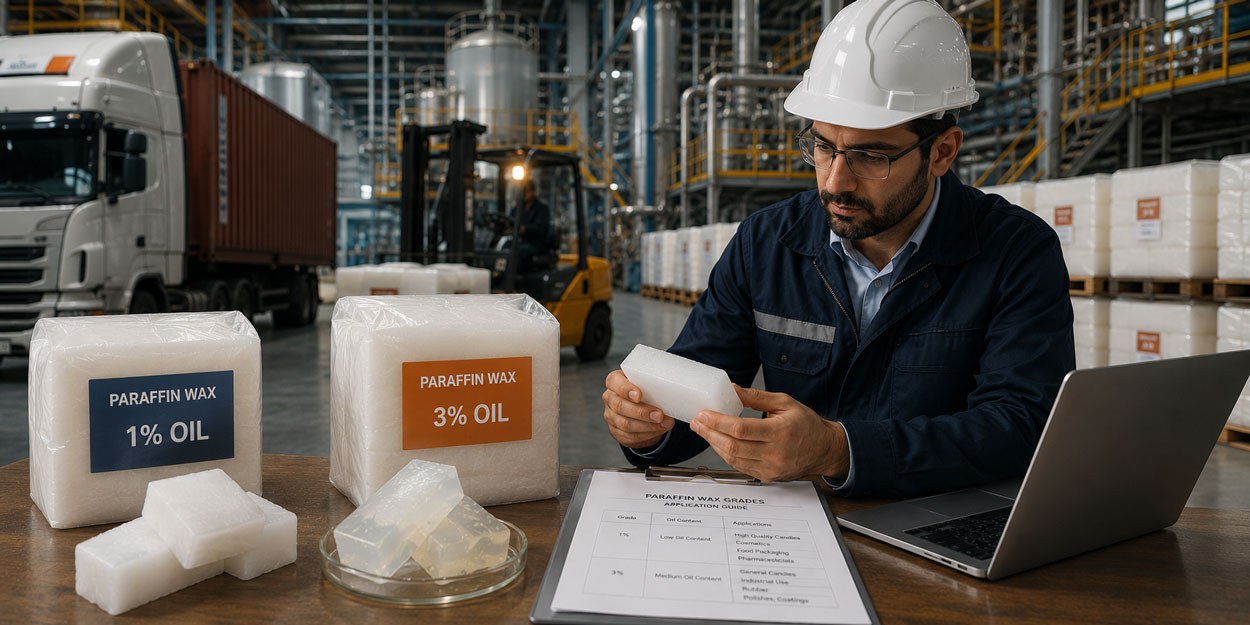
The main difference between 1% and 3% paraffin In Amount of remaining oil It is a matter that directly affects properties such as purity, color, transparency, flexibility, application and price. 1% paraffin has a clearer appearance and higher quality for some specific applications due to less oil, while 3% paraffin is used in many industries and manufacturing processes with a more affordable cost and desirable performance.
Therefore, it cannot be said that one of these two grades is always superior to the other. The best choice is made when the type of application, the required technical characteristics and the budget are considered together. If the goal is to produce high-quality products with a premium appearance, 1% paraffin is a good choice; but for many general and industrial applications, 3% paraffin can also provide the best balance between quality and cost.
Finally, before purchasing, it is recommended that you check the technical specifications and analysis of the product, in addition to paying attention to the oil percentage, and choose a grade that exactly matches the needs of your project or production line.