

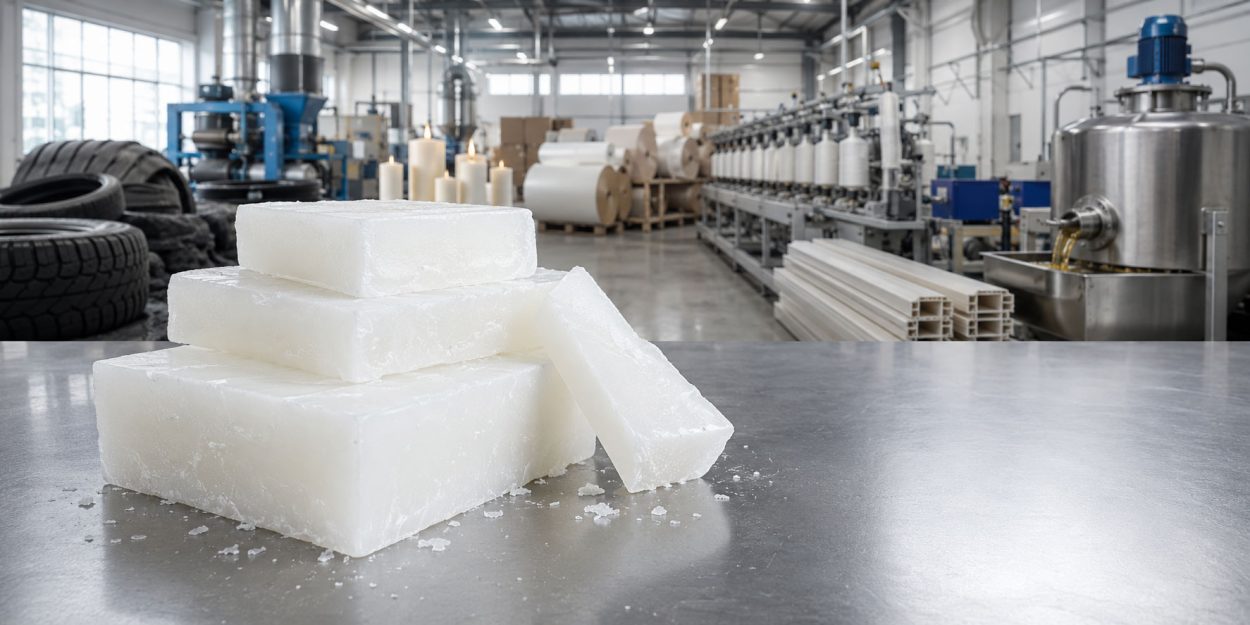
Industrial applications of paraffin wax are not limited to candle making. This hydrocarbon wax is used in many formulations and manufacturing processes to provide a coating, control friction, regulate melt behavior, or aid in product shaping. The type of use depends on the grade, melting point, oil content, color, odor, and end product requirements; therefore, a single paraffin wax is not the right choice for all industries.
In this guide, from Arash Mahya's perspective, we review the most important applications of paraffin wax in various industries and finally explain what specifications should be matched to the process and final product when selecting solid paraffin for a production line. The goal is to have a clearer picture of the role of paraffin wax in your formulation before inquiring or purchasing. In practice, the application of paraffin in industry depends on the required properties of the final material and the process window of the production line.
What is paraffin wax and why is it used in industry?
Paraffin wax is a mixture of saturated hydrocarbons that is usually solid or semi-solid at room temperature. Its important feature for the industrial user is that different grades can be selected based on melting range, oil percentage and level of refinement. This diversity allows paraffin to be used in industry as a process material, coating, lubricant or formulation component.
If your topic is the liquid form of this family of substances, the article What is paraffin oil? It better explains the functional differences between liquid paraffin and solid paraffin wax. You can also compare liquid grades on the page Types of liquid paraffin See.
Industrial applications of paraffin wax at a glance
| Industry/Process | Common role of paraffin wax | Important criteria when choosing |
| Candle making | The main ingredient or part of the wax composition | Melting point, appearance, burning behavior |
| Rubber and tires | Formulation component and creation of a surface protective layer in some compounds | Melting range and compatibility with compound |
| PVC and plastic | External lubricant and processing aid in some formulations | Compatibility and behavior at process temperatures |
| Paper and packaging | Covering and helping to reduce moisture penetration in certain applications | Coating stability and product contact requirements |
| Textile | Waxing yarn and reducing friction in some processes | Hardness, melting and cleanability |
| Cosmetics | Structurer and oil phase component in authorized formulas | Refined grade and quality requirements |
| Colored pencils and ink | Binder, carrier or texture adjuster | Hardness, melting point and pigment compatibility |
| Polishing and coating | Creating a movie and adjusting gloss/smoothness | Hardness and playability |
| Hot melt adhesives | Adjusting viscosity and open time in some formulas | Compatibility with resin and operating temperature |
| Wooden products | Emulsion or coating component to control moisture absorption in certain applications | Emulsion type and process compatibility |
1. Use of paraffin wax in candle making
Candlemaking is the most well-known use of paraffin wax, and paraffin is a common base material in candlemaking. Paraffin wax can be the main ingredient in a candle or part of a multi-wax blend. Depending on the type of candle, mold, essential oil, color, and conditions of use, the manufacturer selects a grade whose melting and solidification behavior is compatible with the process.
In this industry, simply being white is not enough. The melting point of the paraffin, the amount of oil, the uniformity of the batches, and how it works with other additives can affect the production process and the appearance of the product. Therefore, the required specifications may not be the same for molded, container, or industrial candles.
2. Industrial applications of paraffin wax in rubber and tires
In the rubber industry, the use of paraffin in the rubber industry is usually based on the use of some paraffin waxes as part of the compound. These substances can migrate to the rubber surface and form a thin protective layer; the mechanism and extent of the effect depend on the type of wax, the rubber composition, the temperature and the working conditions. For this reason, paraffin in rubber manufacturing should be selected based on the actual formula of the compound, not just on the generic name "paraffin wax".
For this application, the hydrocarbon distribution range and melting behavior are more important than the appearance of the product. Inappropriate selection may result in less or more surface migration than the formulation requires. Consequently, we recommend that the proposed grade is first evaluated on a laboratory or pilot scale with the final compound.
3. Application of paraffin in PVC and plastics industries
One industrial application of paraffin wax in some PVC formulations is as an external lubricant. The purpose of such additives is to reduce melt adhesion to metal surfaces of equipment and to help control process behavior. The amount and grade selected must be compatible with the resin, stabilizers, fillers, and line temperature.
In this application, the melting point and compatibility of the paraffin with the system are of direct importance. Excessive use or selection of an inappropriate grade can affect the processability or surface properties of the product; therefore, there is no single version for all extrusion lines or profile production.
4. Application of paraffin wax in paper, cardboard and packaging
Paraffin wax in paper and packaging is used in certain applications in the form of wax coatings. Paraffin wax is used in the coating of some papers and boards to adjust the surface, slip or resistance to moisture penetration for the intended application. This method is not suitable for all types of packaging and the choice must be coordinated with the type of product, the printing method and the storage conditions.
If the packaging is in contact with food, pharmaceuticals or sensitive products, simply being industrial grade paraffin is not enough and the grade and regulatory requirements of the application must be checked. For general applications, product odor control, color and coating uniformity are usually practical purchasing criteria.
5. Application of paraffin in textiles and yarn waxing
In the textile industry, paraffin is used as a wax or friction reducer in the textile industry, especially in some stages of yarn preparation and passing through equipment. The goal is to make the yarn move more smoothly and control its contact with machine components. The type of fiber, line speed, and subsequent finishing operations determine what hardness and melting range are most appropriate.
The use of paraffin in textiles must also be compatible with the washing, dyeing or finishing step, as the material remaining on the yarn should not interfere with the subsequent process. For this reason, it is important to evaluate the cleanability and wax residue in addition to the mechanical performance.
6. Application of paraffin wax in cosmetic products
In some cosmetic products, refined paraffins can be used as a structurant or as a component of the oil phase of the formula. This does not mean any industrial paraffin available on the market; the grade used must be appropriate to the quality, purity, and regulatory requirements of the final product.
If your goal is to produce a cream, balm, or personal care product, choosing based solely on price can pose a quality risk. The technical specifications and quality documents of the grade should be reviewed before confirming the purchase. The difference between solid paraffin and white oil is also important in formula design and the two should not be considered interchangeable.
7. Use of paraffin wax in colored pencils, inks and color compositions
Paraffin wax is used as a binder or carrier in some colored pencils, hot melt inks, and color compositions. Wax can help regulate hardness, melt, and transfer of the material. Its ratio with pigment, resin, and other waxes determines the texture and behavior of the final product.
In such formulations, pigment compatibility and stability in hot and cold cycling are important. It is best to compare the selected grade with a reference sample of the formula so that changes in the starting material batch do not cause significant fluctuations in the final product.
8. Use of paraffin wax in polishes and protective coatings
Paraffin wax can be used in some polishes, protective coatings, and surface compositions to form films, adjust slip, or modify surface feel. This use may be combined with other waxes, solvents, or emulsions, depending on the product.
In formulas where paraffin must be dissolved in a liquid phase or solvent system, recognition What is paraffin solvent? It can help to separate the issue of "wax" from "wax solvent."
9. Application of paraffin in hot melt adhesives
In some hot melt adhesives, wax is added to the formula to adjust the melt viscosity, set speed, and process behavior. Industrial paraffin wax is a common choice along with other types of wax, but its selection must be compatible with the base resin and adhesive materials.
For this application, it is not just the melting point that is important. Viscosity at operating temperature, thermal stability and the effect of wax on the final adhesion should be investigated in the formulation test. For this reason, comparing samples under actual production line conditions is more accurate than selecting based solely on the specification sheet.
10. Application of paraffin wax in wood products and wax emulsions
Paraffin is used in some engineered wood products, coatings, and wax emulsions to control water absorption or modify surface properties. The method of addition can be direct or in the form of an emulsion, depending on the type of line and the base material.
In this group of applications, proper wax distribution and compatibility with the binders are of great importance. Grade selection should be confirmed by absorption testing, surface appearance, and the final product pressing or coating process.
What characteristics determine the use of paraffin wax?
The application of paraffin wax in any industry is shaped by a combination of several technical characteristics. Two grades with similar appearance can behave differently in the production line. For this reason, in an industrial inquiry, it is better to state the required performance characteristics instead of a general request for "paraffin".
Melting point and melting range
The melting point of paraffin wax determines at what point the wax becomes soft or liquid and when it re-forms. This parameter can affect the process window in candles, hot melt adhesives, PVC, coatings and thread waxing.
Oil percentage
Oil content is a common criterion for distinguishing paraffin grades and is related to hardness, appearance, and behavior in certain applications. The required grade should be selected based on product formulation and testing; lower or higher oil content alone does not mean better.
Color, odor and level of purification
For applications where appearance or odor are important, such as candles, hygiene products, or some coatings, the level of purification and color uniformity become more important. In other technical uses, process parameters may have a higher priority.
Batch supply and uniformity
Paraffin wax can be supplied in slab, granule or other forms. The physical form has a practical effect on storage, feeding and melting speed. For continuous industrial use, consistency of specifications between batches is as important as the specifications of a single sample.
How to choose the right grade of paraffin wax for the production line?
To select a paraffin grade, first determine the application and process conditions: operating temperature, addition method, accompanying materials, expected properties of the final product, and quality or legal restrictions. Then select a sample with close specifications and test it in the actual formulation. This approach is less risky than changing the raw material based solely on price.
- Specify the exact application: candle, rubber, PVC, paper, textile, adhesive or coating.
- Extract the melting point range and oil percentage required from the formula or line experience.
- If color, odor, or purity is important, mention the level of purification and quality documentation in the inquiry.
- Test the sample alongside the actual formula ingredients and at the actual process temperature.
- After sample approval, also monitor the consistency of the specifications of the supply batches.
What is the difference between industrial paraffin wax and liquid paraffin in application?
Industrial paraffin is a general term and the exact grade should be specified. Paraffin wax is typically selected for applications that require a solid structure, melting behavior, film formation, or waxy performance; in contrast, liquid paraffin or white oil is liquid at ambient temperatures and has different roles in lubrication, formulation, and specialty applications. For this reason, the terms “paraffin wax,” “solid paraffin,” and “liquid paraffin” should not be used interchangeably, regardless of physical form and grade.
Summary of industrial applications of paraffin wax
Industrial applications of paraffin wax, or in other words, paraffin wax applications, range from candlemaking and rubber to PVC, paper, textiles, adhesives, coatings and specialty formulations. What these applications have in common is the need to select the grade appropriate to the process; not simply select a material with the generic name paraffin. For this reason, the application of solid paraffin should be defined based on the expected performance, not just appearance or price.
At Arash Mahya, we recommend that you provide the consumer industry, target melting point, oil percentage, supply form, and final product quality sensitivities when making an inquiry. This information helps screen for more suitable options more quickly and allows for more targeted sample evaluation in the production line.
Frequently Asked Questions About Paraffin Wax Application
What is the most important use of paraffin wax?
Candle making is one of the most well-known uses, but on an industrial scale, paraffin wax is also used in rubber, PVC, paper and packaging, textiles, polishes, hot melt adhesives, and some other formulations.
Is one type of paraffin wax suitable for all industries?
No. The appropriate grade is selected based on melting point, oil content, level of refinement, compatibility with formulation materials, and line conditions. A grade that performs well in a candle is not necessarily the right choice for PVC or rubber compounding.
What specifications should we provide for the purchase of industrial paraffin wax?
State the minimum industry of use, desired melting point, oil percentage, color or level of refinement, packaging form, and quantity to be used. If the formula is sensitive, a reference sample or acceptable specification range will also make the selection process more precise.
What is the difference between solid paraffin and liquid paraffin in terms of usage?
Solid paraffin or wax is suitable for roles such as structuring, film formation and control of melting behavior, while liquid paraffin is flowable at ambient temperatures and is used in other formulations and processes. The choice between the two should be based on the required performance.