

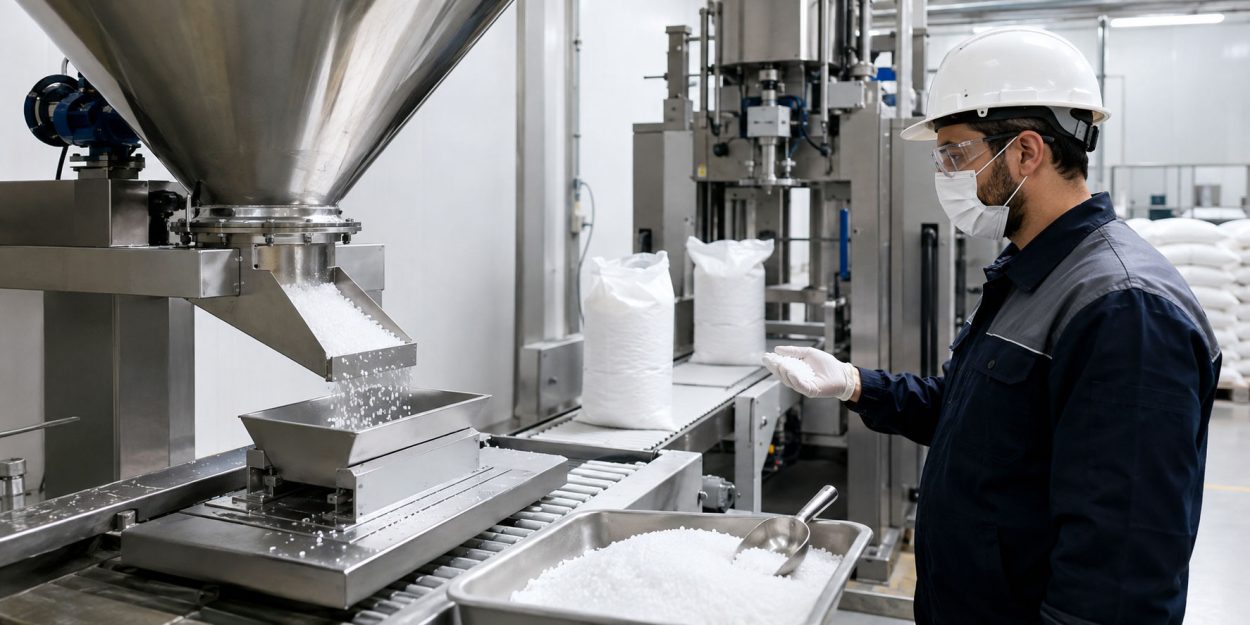
Granular paraffin is a form of solid paraffin that is supplied in the form of small, portable granules rather than slabs or blocks. This form simplifies the measurement, transfer, and feeding of the material for many production lines; however, the selection of the appropriate product must still be based on technical specifications such as oil content, melting point, batch uniformity, and actual process requirements.
At Arash Mahya, the production of granular paraffin is based on light paraffins with low oil content. Our goal in offering this form is to respond to buyers who, in addition to the quality of the base material, value ease of use and stability of supply on an industrial scale. If you are still unsure about choosing the type of paraffin, here is a guide Types of paraffin and its uses It can provide a more general picture of the available options.
What is granular paraffin and how is it different from a new material?
Granular paraffin wax is not inherently a separate family of petroleum waxes; the main difference is in the physical form of the product. After selecting the appropriate grade and forming process, paraffin wax is converted into particles or granules that can be more easily handled in bags, feed tanks, or industrial weighing systems. The term “granular” therefore describes the form of supply rather than indicating higher purity or quality alone.
This distinction is important for purchasing. Two samples of paraffin granules may have the same appearance, but their oil content, melting point or behavior in the process are not the same. For this reason, checking the analysis of the product and matching it to the end use is more important than the appearance of the granules. To more accurately identify the base material, you can visit the page Paraffin wax See also.
Specifications of Arash Mahya Granular Paraffin
In Arash Mahya's current production, light and low-oil paraffin is used to achieve beads with less adhesion and good transferability, and the basis of production is paraffins below 1% oil. However, the final specifications of each order must be matched to the analysis of the same grade or batch, because the melting point and other indicators depend on the base material and the customer's order.
| Index | What to check |
| Physical form | Granular and suitable for feeding and weighing |
| Base material | Light and low-fat solid paraffin |
| Oil percentage | Below 1% in Arash Mahya's current granulated product; final confirmation with COA |
| Melting point | According to the order grade and analysis; do not use a generic number for all orders. |
| Quality control | Checking the consistency of specifications in the batch, appearance and compliance with the production line requirements |
| Technical documents | In industrial orders, the COA and agreed specifications are the basis for acceptance. |
Why is the percentage of oil in granular paraffin important?
The residual oil content is one of the important indicators in the selection of granular paraffin. More oil can make the texture softer and increase the tendency of the grains to stick together; therefore, in the production of granules, the use of light and dry paraffin has a practical advantage. The term 1% granular paraffin in the market usually refers to a product whose Oil Content is in the low range, but the buyer should check the actual amount on the analysis sheet.
If oil percentage is a determining factor in your purchasing decision, the article Difference between 1% and 3% paraffin Provides more details on the effect of Oil Content on properties and grade selection.
Don't guess the melting point from the granular form.
The granularity of the product does not determine the melting point. Granular paraffin can be produced in different grades, and each grade has its own thermal behavior. If the material is to be fed into a melter, extruder, mixer, or coating process, the melting point must be compatible with the operating temperature of the equipment and the final product. For this reason, we recommend that the required number be taken from the order specification and COA, not from a generic range on the Internet.
What is the difference between granular paraffin and solid slab paraffin?
The base material in both cases can be solid paraffin, but the form of supply affects how the material is handled. The main advantage of granular paraffin is seen in lines where step weighing, controlled feeding or melting in specific batches is used. The granules have a larger contact surface than a large block and, under the same conditions, can provide a more uniform distribution and melting in the tank.
| Quality | Granular form | Slab/Block Form |
| Weighing small quantities | Simpler | Requires chopping or cutting |
| Feeding the equipment | More suitable for dosing systems | Depending on the equipment, preparation may be required. |
| Contact surface during melting | More | Less for large parts |
| Storage and packaging space | Bag and bulk density dependent | Depends on slab dimensions and palletizing method |
| Chemical quality | Grid and analysis function | Grid and analysis function |
The important point is that "granular" alone does not mean higher purity. When buying professionally, physical form and chemical characteristics should be considered as two separate criteria.
Applications of granular paraffin in industry
The application of granular solid paraffin depends on the grade, oil content, melting point and the consumer formulation. The granular form adds more value when the production line requires regular feeding and control of the amount of material. Before use in each formulation, the sample and technical specifications should be adapted to the actual production conditions.
Rubber and waxy compounds industries
Paraffin wax is used in some rubber formulations and wax-based protective compounds. In this area, simply having a low oil content is not enough and the hydrocarbon distribution, migration behavior and process conditions are important. The form of paraffin granules can simplify weighing and adding the material to the mixer, but the choice of grade should be made with the formulation of the technical unit.
Polymer and PVC
In some polymer processes, paraffin wax is used as an external lubricant and to reduce melt adhesion to metal surfaces of equipment. In such applications, paraffin granules can be practical for dosing and mixing due to their granular form. However, compatibility with the resin, dosage, and effect on the final product must be confirmed in production line testing.
Candle making and melting processes
In units where the paraffin is first weighed and then melted, granular paraffin allows for the division of the feed amount without crushing the slab. This feature is useful for a manufacturer who has several formulas or batches of different weights. The quality of the final candle is still dependent on the melting point, oil percentage, additives, wick type and process control and is not guaranteed by the choice of granular form alone.
Coatings and other industrial uses
Paraffin wax is used in some coatings, paper, and industrial compounds due to its hydrophobicity and thermal behavior. If you intend to use paraffin wax in such a process, you must first determine the product contact requirements, operating temperature, safety requirements, and standards of the target industry. For sensitive food, pharmaceutical, or cosmetic applications, you should not rely solely on the name of the paraffin; the grade and standard compliance must be verified separately.
What criteria should we consider when choosing granular paraffin?
When purchasing industrial paraffin, the best choice is not simply a product that is “whiter” or “less oily”; the best option is a grade that is compatible with your process and provides consistent specifications across repeat orders. Consider these seven criteria before purchasing paraffin wax granules:
- End use: Specify whether the material is used in a candle, rubber, polymer, coating, or other process.
- Oil percentage: Determine the acceptable oil content limit from formulation or production line experience.
- Melting point: Determine the required range for equipment and final product.
- Grain shape and size: Evaluate feeding, conveying, and melting capabilities with existing equipment.
- Batch consistency: One good sample is not enough; repeatability of specifications is important in continuous supply.
- Technical documentation: Use the COA or agreed analysis as the basis for delivery control.
- Packaging and shipping conditions: Specify package weight, palletizing, storage temperature, and shipping destination before ordering.
What factors does the price of granular paraffin depend on?
The price of granular paraffin is not a fixed number and varies with the specifications of the base material, oil percentage, grade, order volume, packaging type, shipping costs and market conditions. In industrial orders, price comparison is meaningful when two offers are truly equivalent in terms of technical specifications. A cheaper product with a different Oil Content or melting point does not necessarily mean a more economical purchase.
To get a price for paraffin granules, it is best to state the application, quantity required, destination, packaging, and desired specifications when inquiring. This information helps the technical and commercial proposal to be closer to a product that can actually be used in your line.
Buy paraffin granules from Arash Mahya
Arash Mahya has been active in the field of manufacturing and exporting industrial waxes since 2002, and the production of this product is carried out in the Eshtehard factory complex. When ordering granular solid paraffin, our focus is on matching the base material and product specifications with the buyer's application; especially in bulk purchases where quality consistency between shipments becomes more important.
To purchase paraffin granules, it is best to provide the sales team with technical information about the line or at least the end use before placing an order. If necessary, you can use the following route: Contact Arash Mahya To inquire about inventory, supply conditions, samples or technical documents, please visit the article to learn about the general process of wax refining and preparation. Paraffin Production Process Available.
Frequently Asked Questions about Granular Paraffin
Is granular paraffin the same as solid paraffin?
Yes, in this application, granular paraffin refers to the granular form of solid paraffin. Granularity determines the form of supply, and the chemical characteristics should be checked based on the grade and analysis of the product.
What does 1% granular paraffin mean?
1% granulated paraffin refers to a product with low oil content. At Arash Mahya, light paraffins with oil content below 1% are used to produce granules, but the exact quantity of each order must be controlled from the COA of the same batch.
Does the granular form cause it to melt faster?
Compared to a large block under similar conditions, smaller grains provide more surface area for the heating process and can make melting easier to manage. The actual melting rate depends on grain size, batch mass, tank type, agitation, and equipment heating capacity.
What information should we provide to purchase paraffin granules?
The end use, order volume, oil percentage required, target melting point if any, packaging type and shipping destination are the main information for the inquiry. The more accurate this data is, the more accurate the grade selection and supply terms will be.
Is granular paraffin suitable for any food or pharmaceutical application?
No. Use in sensitive areas depends on the grade, degree of purification and compliance with relevant standards. Granular form alone does not confer food, pharmaceutical or cosmetic use and this must be confirmed for the specific product and the documentation for that grade.
Conclusion
Granular paraffin is a solution for supplying and consuming solid paraffin in granular form; a form that can simplify weighing, feeding and melt management in many lines. At the same time, the purchasing decision should not be based solely on the appearance of the granules. Oil content, melting point, batch stability, technical analysis and application compatibility are the main selection criteria.
If you are looking for granular solid paraffin for industrial use or bulk supply, please share your expected specifications and line conditions with us so that the appropriate grade can be reviewed based on the actual project needs.