
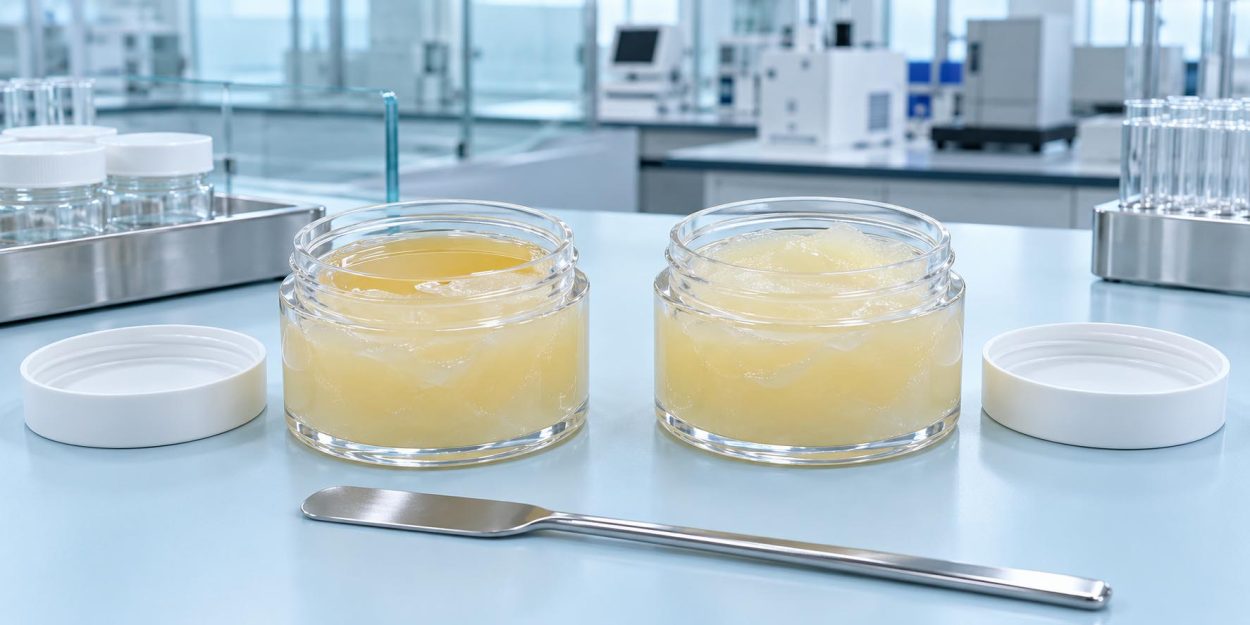
Oiling of industrial petroleum jelly means that part of the liquid separates from the semi-solid mass and appears as an oily layer or accumulation. This sign alone does not prove contamination, spoilage, or the usability of the product. To find the cause, the grade composition, heating and cooling history, transportation and storage conditions, and the condition of the control sample must be examined together. In this guide, we at Arash Mahya explain the investigation path from recording the initial condition to controlled comparison; corrective action makes sense when the cause is identified with sufficient evidence.
What is the difference between oil separation and pollution?
Separation of petroleum jelly is a physical description; that is, a portion of the liquid is observed to be separated from the main mass. Contamination is the presence of an unwanted substance in the product. For example, the observation of free liquid alone does not determine whether the liquid is a component of the product itself or has another origin. A final diagnosis may require laboratory examination.
Softening is not the same as separation. The sample can soften at higher temperatures and still remain uniform. Also, surface gloss, bubbles, visible grains, and foreign particles should not be reported under one name. Before handling the sample, photograph its appearance in steady light and record the location, extent, and time of the mark.
If the container is damaged, the seal is broken, or there is a possibility of foreign matter entering, don’t simply label the issue as “oil spillage.” Separate suspect packages for QC review and stop using them until the situation is determined. The intact appearance of the package alone does not indicate the origin of the liquid.
Composition factors, thermal history and storage
Grid combination and semi-solid structure
Petrolatum is composed of oily and waxy hydrocarbon components, and grades can vary in consistency and behavior. The variation in these properties is explained in the technical introduction to petrolatum. Therefore, do not generalize an observation to all petroleum jelly without examining the grade specifications.
A change in feed or composition is one of the hypotheses to investigate. To track it down, compare the grade code, raw material batch, production records, and product test results. “The product is soft” or “has more oil” alone does not prove the cause. Even if a composition change is recorded, its relationship to the defect should be investigated.
The history of heating, cooling, and stirring
In the study of petrolatum structure, the dependence of rheological behavior on temperature and thermal history has been shown. The practical consequence for troubleshooting is that we do not just ask the sample's current temperature; the previous thermal path must also be known. This study does not determine the cause of oiling of any industrial shipment or a general cooling order.
Record the hot hold time, cooling status, and reheating times. The history of stirring and sample collection is also important; research on petrolatum shear sensitivity has examined the effects of temperature and mechanical shear on structure by evaluating segregation and rheology. Therefore, a sample that has been mixed prior to testing does not necessarily represent the initial state of the package.
To understand the general path of the process, Guide to how to produce industrial Vaseline Read. The goal here is to find the effective difference between the samples, not to provide a formula or production settings.
Transport, storage and container condition
Check the departure date, arrival time, storage location, and any valid temperature records. Proximity to a heat source, changes in storage location, or opening of the container are all factors to consider; none can be definitively determined without evidence. Also, do not equate the absence of temperature records with “appropriate conditions.”
In Sonneborn Maintenance and Durability DocumentThe durability of the products in that series is considered dependent on storage and handling conditions. This document does not replace the instructions for the grade purchased from Arash Mahya; the permitted temperature and time should be checked from the documents of the same product.
Inspection of control samples and shipments
A control sample is a sample of known identity and history from the same batch that is held for comparison. A sample without traces or a product from a different batch is not an equivalent control. If the control was stored in a different container or under different conditions, this difference should be taken into account in the interpretation.
Before homogenization, record the status of the packages received. If only one container is inspected, do not attribute the result to the entire shipment. The number and location of sampling should be consistent with the approved QC plan. A portion of the sample should also be retained, unchanged and traceable, for subsequent inspection, if possible.
Production, control and warehouse sample comparison form
Record the following separately for each of the three groups. This form is a data collection guide and does not report the actual results of a shipment.
| Comparison data | Production sample | Control sample | Warehouse or shipment sample |
|---|---|---|---|
| Identity and time | Grade code, batch and harvest time | Batch matching and shelf life | Batch, time of receipt and container number |
| Condition history | Filling and cooling status | Container and storage conditions | Transportation route and verifiable warehouse conditions |
| Initial appearance | Liquid layer and texture uniformity | View before manipulation | Surface condition, seals and package discrepancies |
| Change history | Registered heating or stirring | Every time it is opened or removed | Any action after receipt |
| Comparison result | Observation method, conditions and time | Same method and conditions | Same method and conditions |
Initial causal tree
Start at step one and move on to the next path based on the answer. This tree indicates the priority of investigation and does not make a final judgment about the cause.
| Step and question | Positive response path | Negative response path |
|---|---|---|
| 1. Is there a possibility of contamination or damage to the package? | Separate the package and refer to QC; contamination check is a priority | Go to step 2 |
| 2. Do we have a traceable and comparable control sample? | Go to step 3 | Complete tracking; attribution of defect to production or shipment remains suspended. |
| 3. Is the sign visible on both the witness and the shipment? | Examining common factors; feed, process, and witness history | If only the cargo is involved, container, handling and storage discrepancies should be investigated. |
The health of the control does not alone exclude the production from consideration; the control sample may not be representative of all batches. The involvement of both groups also does not prove the inappropriate formula, as their common or different histories remain to be clarified.
Controlled comparative trial
Write the test plan before you start: the main question, samples, observation or measurement method, conditions and acceptance criteria should be clear. The evaluation temperature, waiting time and sample preparation method should be the same and recorded. Changing several factors simultaneously makes it difficult to distinguish the effect of each.
If the amount of separation is measured, the method of separation and measurement of the liquid and the reporting unit should be clear. Layer heights in differently shaped containers are not necessarily comparable. Consistency can also be complementary data; ASTM D937 It is tested by cone penetration into petrolatum, but the consistency result alone does not confirm the stability or performance of the application.
Report the initial measurement of the intact sample separately from the test for the effect of a different condition. The test conditions should be determined by the technical officer. If an accelerated test is performed, do not translate the result into actual product life without a validated relationship. A single numerical limit for lubrication of all grades cannot be derived from this guide.
Corrective action after diagnosis
To record the "grain texture of petrolatum," first clarify whether the heterogeneity is the substance itself or possible foreign particles. Visual observation is only the beginning of the investigation. The table below links the hypotheses to the discriminant data; no row is a definitive version of the correction.
| Sign | Possible cause to investigate | Discriminant data | Authorized action |
|---|---|---|---|
| Free liquid with intact package | Physical or liquid separation of unknown origin | Control comparison and liquid identification if needed | Recording the status and QC decision on whether to continue the assessment |
| Strong differences between dishes | Differences in filling, history or local conditions | Container tracking and comparison of multiple samples | Checking the scope of the defect before generalizing to the batch |
| Grainy texture | Structural changes or foreign particles | Process history and appropriate laboratory testing | Preserving the original sample and isolating the source of heterogeneity |
| Change with seal damage | Possibility of contamination | Container status and unwanted material inspection | Separation and assignment according to quality procedure |
Accidental addition of wax, addition of oil or reheating is not a universal remedy. These actions can change the evidence of the initial condition. If reprocessing is considered, there should be an approved order, control limits and re-evaluation of the product; the temporary disappearance of the liquid layer is not a confirmation of the quality of the shipment.
Is every oil spill a sign of corruption?
No. The presence of free liquid alone does not prove spoilage and is not a permit for use. The decision to accept, use, retest or reject depends on the agreed specifications, contamination investigation and the need for use.
How to separate the effect of storage from composition and process?
With traceable samples, reliable records, and conditional comparisons. If you don't have enough data, record the cause as "undetermined." The similarity of one symptom to another experience is not a substitute for evidence of the same cargo.
Problem analysis based on cargo data
Track industrial petroleum jelly oiling from initial condition recording, tracking and comparison of evidence, and keep corrective action dependent on diagnosis. We at Arash Mahia are ready to review Specifications of industrial VaselineWe pay attention to the exact description of the usage and the conditions of observation. Please send the necessary specifications, quantity and delivery destination along with a description of the problem so that the basis of your request is clear.